
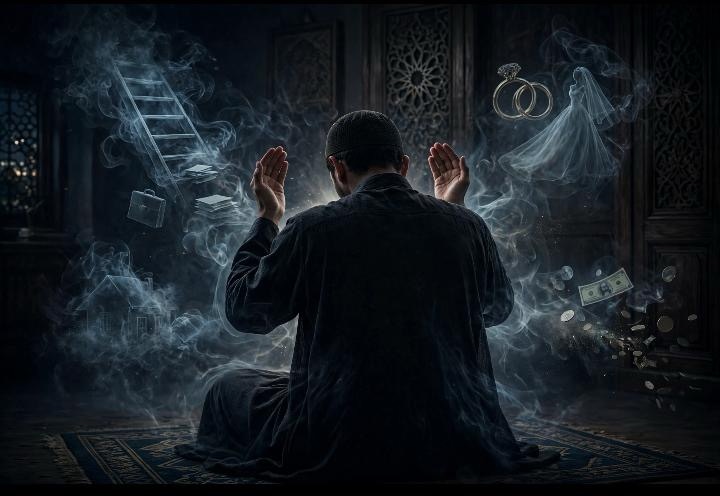
Much of life is measured through events. We speak about getting married, building a career, having children, starting a business, becoming financially independent, buying a home, or reaching a certain level of success. These events become milestones by which we quietly measure whether our lives are progressing as they should. Yet, amid all this conversation about what is happening in our lives, there is one relationship we rarely stop to examine: our relationship with Allah.
Perhaps one of the most important questions a believer can ask is not simply, “What is happening in my life?” but, “What is happening to my relationship with Allah because of what is happening in my life?”
When Life’s Events Begin to Define Us
A career can be a blessing, but it can also become a source of heedlessness. Marriage can bring tranquillity, but it can also become a source of attachment that takes precedence over obedience to Allah. Wealth can provide security and allow a person to serve others, but it can also create an attachment to the dunya that slowly hardens the heart. A business can become a means of providing for people and creating benefit, or it can become an endless pursuit of status and recognition.
The event itself does not tell the entire story. What matters is what that event is doing to the person experiencing it. This is something people from the outside can rarely see.
People see the marriage, but they do not see what happens to the heart within that marriage. They see the promotion, but they do not see whether the person has become more grateful or more arrogant. They see the successful business, but they do not know whether its success has increased a person’s generosity or attachment to wealth. They see the photographs, the titles, the achievements and the celebrations, but the inner reality belongs to the person and, ultimately, to Allah.
This is why becoming overly concerned with the timing of worldly events can be so exhausting. We worry about what people will say if we are not married by a certain age, if our career does not develop according to expectations, if our business does not succeed quickly, or if our lives look different from those around us. We become so occupied with meeting the expectations of people that we sometimes forget to ask whether the life we are pursuing is pleasing to Allah.
When the Question Changes From “What Will People Say?” to “Is Allah Pleased With Me?”
There is a quiet freedom that comes when a person begins to understand this. They may still listen to people, respect advice and care about their responsibilities, but the opinions of people no longer become the measure of their worth. Their ultimate concern becomes whether they are living in a way that Allah is pleased with. Delays may still hurt, but they no longer necessarily break the heart. Hardship may remain difficult, but it can become a means of turning back to Allah. Losing something may still bring grief, but the person begins to understand that not everything lost in this world is truly a loss.
Sometimes what we call a delay may be protection. Sometimes what we call deprivation may be mercy. Sometimes losing something we desperately wanted may prevent us from losing something far more valuable: our relationship with Allah.
This does not mean that every successful person is distant from Allah or that every person experiencing hardship is close to Him. Outward circumstances alone cannot tell us the condition of someone’s heart. A person may have wealth and possess gratitude. Another may have very little and still struggle with attachment, envy or discontentment. Allah knows what is hidden within every person.
The important question, therefore, is not whether our lives look successful from the outside. It is whether the things we are pursuing are shaping us into people who are more obedient, grateful, humble and conscious of Allah.
Why Does Our Relationship With Allah Become Damaged?
The danger begins when a person stops caring about what Allah thinks and becomes consumed by what people think. A person may know that something is wrong but refuse to accept it because accepting the truth would require them to surrender something they deeply desire. Sometimes it is a relationship. Sometimes it is wealth. Sometimes it is an ambition, a reputation, a lifestyle or an image they have built for themselves. The difficulty is not always in knowing the truth. Sometimes the difficulty is in accepting what the truth requires us to give up.
That is where the heart needs to be watched carefully.
How Do We Keep Watch Over Our Relationship With Allah?
A believer needs moments of honest self-examination, not only during major difficulties but also on ordinary days when life appears to be going well. One useful moment for this reflection is at the end of the day, before going to sleep.
What did I do today that brought me closer to Allah?
Where did I become careless?
Did I compromise something I knew was right?
Did I seek people’s approval more than I sought Allah’s pleasure?
Did I make a mistake and genuinely regret it, or have I become so accustomed to it that my heart no longer reacts?
There is a difference between merely asking for forgiveness and recognising the seriousness of what we have done. Istighfar should not become a routine phrase that the tongue repeats while the heart remains indifferent. When a person truly recognises a wrong, there is regret within them and a sincere desire to return to Allah.
This kind of self-accountability protects a relationship that can easily be neglected.
The Question We Should Keep Returning To
The dunya will continue presenting us with things to pursue. There will always be another achievement, another financial milestone, another social expectation and another person whose life appears to be ahead of ours. If we allow these things to become our primary measure, we may spend our entire lives chasing events without examining the direction in which those events are taking us.
Perhaps the more important question is not “When will this happen for me?”
Perhaps it is: “If this happens, who will I become?”
And even more importantly: “Will this bring me closer to Allah or further away from Him?”
A career, marriage, family, business, wealth and every other blessing can be beautiful when they remain within their proper place. But none of them is worth sacrificing the relationship for which we were created. The world may judge our lives by what it can see. Allah knows what is within them. And perhaps the real success of a life is not simply in how much happened within it, but in where those events took the heart.

