
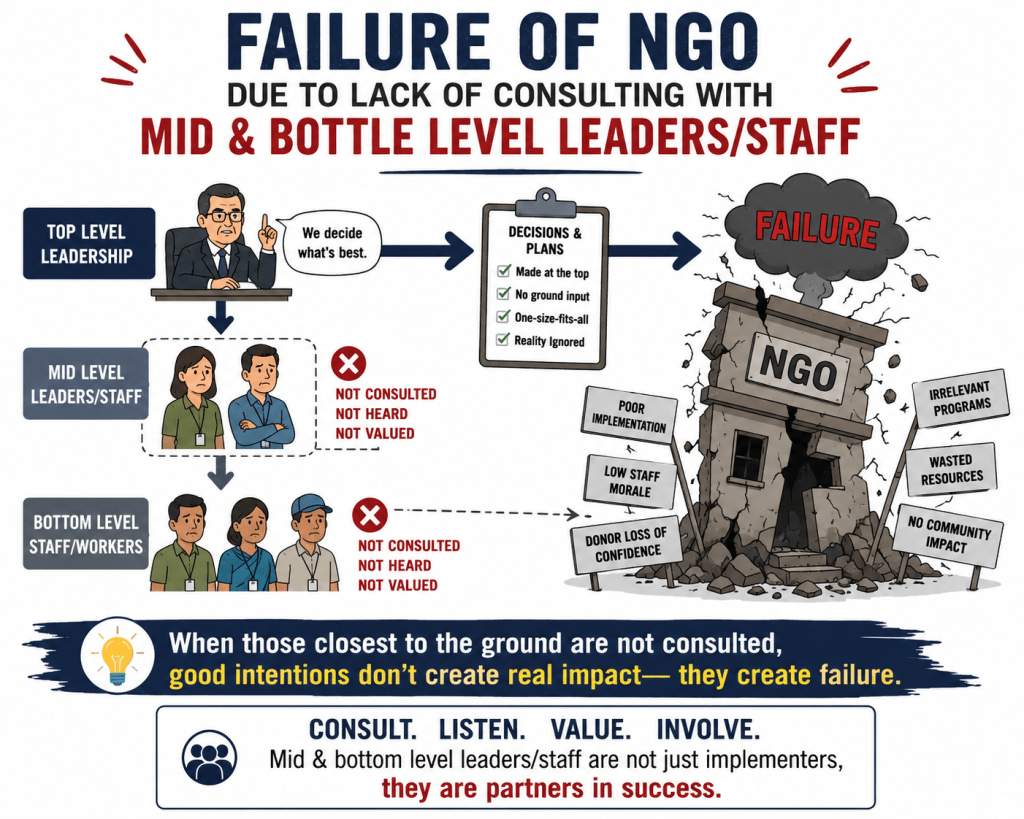
In the humanitarian and social development sectors, the vision is often grand: eradicating poverty, championing education, or restoring ecosystems. These visions are crafted in boardroom meetings by executive directors and top-tier leadership. However, there is a recurring, systemic failure that turns these visionary strategies into operational ghosts: the exclusion of mid-level and front-line leadership from the strategic decision-making process.
When NGOs operate as top-down hierarchies that only consult the “C-suite,” they inadvertently cultivate a culture of disengagement, operational friction, and ultimate failure.
The Illusion of Top-Down Strategy
Many NGOs fall into the trap of believing that strategy is the sole domain of executive leadership. While top-level leaders hold the responsibility for organizational health and fundraising, they are often furthest removed from the “boots on the ground” reality.
When leadership designs programs, workflows, or cultural shifts without consulting the people who must actually implement them, they create a “disconnect gap.”
The Consequences of the Disconnect
Operational Inefficiency: Policies crafted in isolation often fail to account for local complexities, resource constraints, or cultural nuances that front-line workers navigate daily.
The “Feedback Vacuum”: When mid-level managers (program officers, field coordinators) and bottom-level staff or volunteers are not heard, their valuable insights regarding what is actually working—and what is failing—never reach the decision-makers.
Erosion of Ownership: If employees and volunteers feel they are merely executors of someone else’s vision rather than co-creators of impact, they lose their sense of agency. This leads to burnout and high turnover.
Wasted Investment: Motivational seminars, expensive workshops, and mission statements are effectively wasted when the people expected to embody them feel alienated by the very leadership preaching these values.
Bridging the Gap: A New Model of Inclusive Leadership
To succeed, NGOs must transition from a command-and-control model to a collaborative ecosystem. This requires a fundamental shift in how leadership is perceived and practiced.
1. Institutionalize Feedback Loops
Feedback should not be an annual survey; it must be part of the organizational DNA.
Implementation: Create “Impact Councils” consisting of staff from different levels of the organization. These councils should meet quarterly to review the effectiveness of top-down strategies.
2. Value “Contextual Intelligence”
The people working in the field possess the most accurate data regarding the success of a program.
Implementation: Leadership should adopt a “Listen-First” approach. Before a new project is launched, the leadership team should spend time in the field, not just observing, but actively soliciting the opinions of those who will handle the day-to-day execution.
3. Empower Mid-Level Managers
Mid-level managers are the bridge between strategy and execution. Often, they are the most overworked and the least consulted.
Implementation: Give mid-level leaders the authority to adapt strategies to local contexts. When they feel trusted, they become the strongest advocates for organizational goals, translating vision into actionable tasks for their teams.
4. Recognize the Volunteer as a Stakeholder
Volunteers are often the lifeblood of an NGO, yet they are rarely consulted on operational strategy.
Implementation: Treat volunteers as internal partners. Engaging them in the process of improvement creates a sense of belonging that is more powerful than any motivational speech or incentive program.
The Bottom Line: Inclusion is Operational Strategy
When an NGO ignores its middle and bottom layers, it effectively blinds itself. You cannot solve a problem you do not understand, and you cannot understand a problem if you refuse to listen to those closest to it.
Leadership in the non-profit sector is not about holding the most power; it is about facilitating the most impact. By dismantling the silos that keep top-level leaders isolated, NGOs can ensure that their strategies are not just visionary, but viable. True organizational resilience is built from the bottom up.
When your team feels heard, they don’t just execute your orders—they own your mission. And that is the only way to turn ambitious visions into lasting, systemic change.

